
Mobile battery replacement · Battery keeps going flat
Repeat Flat Batteries — Rushall battery replacement & Diagnosis
Flat again in Rushall? We measure quiescent current and alternator output before selling anyone another battery. Mobile Battery Replacement, 24/7.
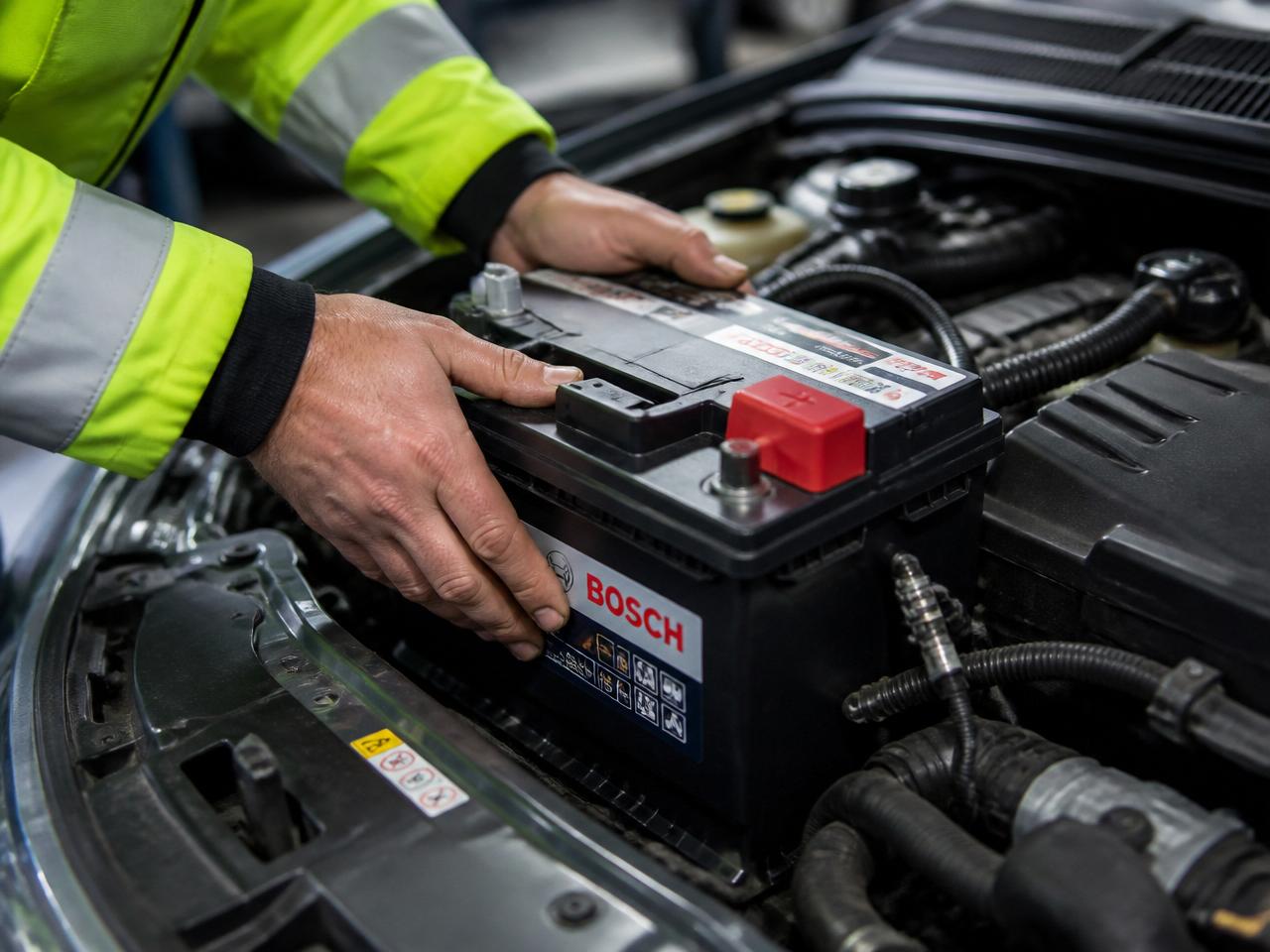
A healthy vehicle should draw around 20–50 milliamps once everything has gone to sleep. A faulty module, an aftermarket alarm or a stuck relay can pull ten times that, which flattens a good battery in two or three days.
Mobile battery replacement across Rushall and the WS4 area, with the correct AGM, EFB or standard flooded chemistry fitted the first time — not whatever's on the shelf.
Stock on the van covers every popular fitment: standard flooded 063/096/075/100, EFB start-stop, and AGM 019/017 for premium and stop-start applications.
How a drain is actually traced
- Charge acceptance is tested, because a sulphated battery can read 12.6V and still hold almost no usable energy.
- Alternator output is checked under electrical load with headlights, blower and heated screen on, not just at idle.
- OBD battery registration for BMW, Audi, VW, Mercedes, Ford, Vauxhall, Peugeot, Citroen — included in the fit price
- Battery Replacement work here is judged against the vehicle's own specification rather than a generic pass mark.
Usage patterns that flatten good batteries
We see this pattern often with cars used for short journeys around Rushall — a 10-minute trip never replaces the charge that starting consumed, so the battery slowly sinks regardless of health.
Locally that means the streets between Rushall and Walsall, with access via M6 J7/J9/J10 and A34 and a practical radius reaching Walsall (~2 mi) and Bloxwich (~3 mi).
Who this page is for
Owners in Rushall on their second or third battery for the same vehicle.
Domestically, 1930s semis and modern estates dominate around here, which shapes how these jobs are accessed and worked.
Drain faults found nearby
Recent job nearby: a car in Rushall on its third battery in two years. Drain measured at 480mA, traced to a boot latch microswitch keeping a module awake.
Recent job nearby: a vehicle off M6 J7/J9/J10 flattening weekly. Alternator produced 13.1V under load — replaced the charging fault, kept the original battery.
Repeat flat battery questions
Q.What's the difference between AGM and EFB?
AGM is a fully sealed absorbed-glass-mat battery for premium and stop-start; EFB is an enhanced flooded battery for entry-level stop-start. Fitting the wrong one is a warranty-void job.
Q.Is a parasitic drain always an electrical fault?
No. Sometimes it is an aftermarket dashcam, tracker or alarm wired to a permanent live. Those are the easy wins and we find them first.
Q.How long does drain testing take?
Allow around an hour. Most of that is waiting for the vehicle's modules to sleep — rushing it produces a meaningless number.
Q.Could short journeys alone be the cause?
Yes, and it is more common than people expect. If that is what the readings show, the fix is a conditioning charge and a change in usage, not another battery.
Q.Do you cover Rushall and the WS4 area for this?
Yes. Rushall is inside our routine coverage from Oldbury via M6 J7/J9/J10, roughly 2 miles from Walsall. We cover it alongside Walsall and the surrounding streets.
Q.Will I lose my radio code and seat memory?
No — we use a 12V memory saver on the OBD port during the swap, so all adaptations and settings are preserved.
How the visit runs
- 1
How a drain is actually traced
Quiescent draw is measured after the vehicle's modules have gone to sleep, which can take 20–40 minutes — measuring too early gives a false high reading.
- 2
Vehicle lookup
By reg on the phone — we confirm the exact OEM battery spec before quoting.
- 3
Fixed all-in price
Battery, fitting, coding, recycling, warranty — one number on the phone.
- 4
Driveway fit
Memory saver in, old battery out, new one in and terminals torqued to spec.
Why this is safe to book
- We will not sell a battery to a car whose battery is not the fault.
- Fixed prices agreed before dispatch — no callout fee just to open the bonnet in WS4.
Where we test
Rushall sits about 2 miles from Walsall, and the same van covers Walsall (~2 mi), Bloxwich (~3 mi) and Aldridge (~4 mi) on the same run.
Related pages
- Fleet & Business Jumpstart — battery keeps going flat in Rushall
- 24/7 Emergency Jumpstart — battery keeps going flat in Rushall
- Start-stop and AGM systems — battery replacement in Rushall
- Stranded in a car park — battery replacement in Rushall
- Taxi and private hire — battery replacement in Rushall
- Battery keeps going flat in Walsall (~2 mi)
- Battery keeps going flat in Bloxwich (~3 mi)
- Battery keeps going flat in Aldridge (~4 mi)
- Battery keeps going flat across Walsall
- Battery Replacement in Rushall — main page
- All jumpstart services in Rushall
Flat again?
Third battery in two years is a diagnosis problem. We measure the draw and the charging output before anything is replaced. We route in via M6 J7/J9/J10, roughly 2 miles out from Walsall.
The short version
Repeat failures are solved with a meter, not a parts catalogue. Find the drain, fix the cause, and the next battery lasts its full life. Locally this is handled alongside Walsall and Bloxwich, so the van is rarely far away.
Stranded with a flat battery?
Call now or send a WhatsApp — we'll confirm your quote and dispatch the nearest engineer.