
Mobile car jumpstart · Slow crank on cold mornings
Slow Cranking On Cold Mornings — Car Jumpstart, Marston Green
Engine turning over slowly on cold mornings in Marston Green? Cold cranking capacity fades before a battery dies outright. On-site testing and car jumpstart,
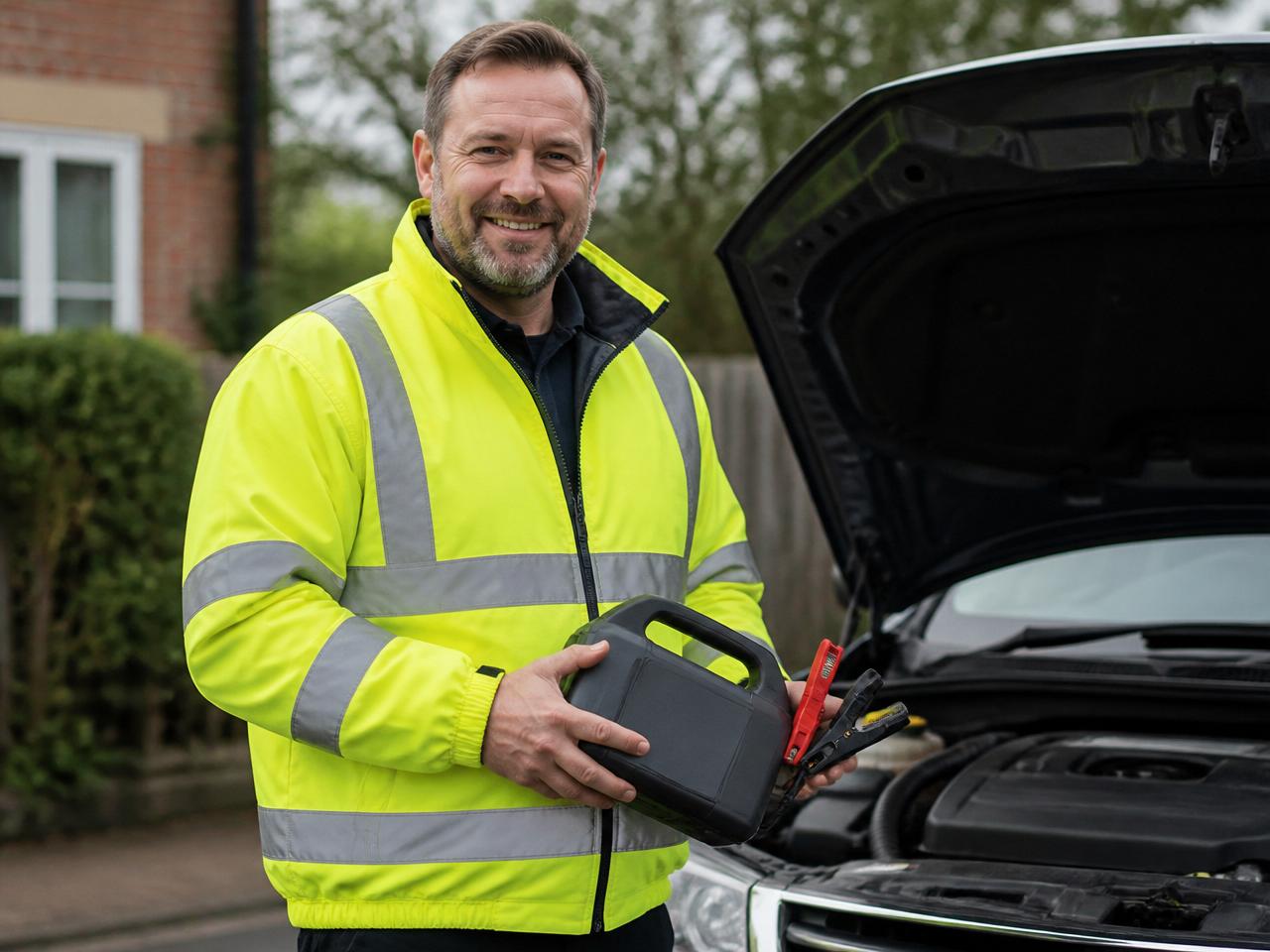
A battery rarely dies in one go. It loses cold cranking amps gradually, and the first sign is a starter that drags for a second longer than it used to on a frosty morning — while starting perfectly at lunchtime.
Car dead on the drive in Marston Green? Most no-starts we see across B37 are just a flat battery from short journeys, a boot light left on, or an aged battery that finally gave up on a cold morning.
Cars in Marston Green get a lot of school-run and short-hop use, and that's the number-one killer of car batteries — the alternator never gets long enough to fully replace what the starter took out.
Typical callers with this symptom
Drivers of older vehicles on 1930s semis who would rather replace on their own terms than be stranded.
Domestically, 1930s semis and airport-related flats dominate around here, which shapes how these jobs are accessed and worked.
Why cold weather exposes a tired battery
Exposed driveways and unheated street parking around Marston Green make this worse — a car on an open B37 street loses more heat overnight than one tucked between buildings.
Locally that means the streets between Marston Green and Solihull, with access via M42 J4/J5 and A34 Stratford Road and a practical radius reaching Solihull (~3 mi) and Shirley (~2 mi).
Recent cold-start jobs nearby
Recent job nearby: an estate car on a driveway off M42 J4/J5, cranking slowly for a week. Rated 640 CCA, tested at 310 — replaced with a matched unit and the slow crank went away entirely.
Recent job nearby: a small city car near Birmingham Airport that started fine on test but showed a 0.4A parasitic drain from an aftermarket accessory — the real cause of the morning struggle.
The tests that predict a winter no-start
- Charging system output is checked at idle and at 2,000rpm, since a weak alternator makes cold-start symptoms appear months early.
- Cranking voltage is watched live — anything dipping below 9.6V while turning over indicates a battery near the end of its usable life.
- Voltage checked before and after — we know within 30 seconds if the battery will hold charge or if it's terminal
- On a car jumpstart the equipment is matched to the vehicle — cranking current, terminal layout and battery location all change the approach.
Local reference data — Marston Green
- Service covered here
- Car Jumpstart
- Main routes
- M42 J4/J5 · A34 Stratford Road · A45
- Typical property
- 1930s semis and airport-related flats
- County
- West Midlands
- Postcode districts
- B37
- Local commercial context
- aerospace and airport services
Catch it before the frost does
A ten-minute cold cranking test in Marston Green is cheaper than a morning spent waiting at the kerb. We route in via M42 J4/J5, roughly 3 miles out from Solihull.
Areas we reach quickly from here
Working out from B37, the practical radius for a car jumpstart takes in Solihull, Shirley, Olton and Knowle — all within a few minutes of M42 J4/J5.
Cold starting questions
Q.How long should I drive after a jumpstart?
Ideally 30–45 minutes of continuous driving, not stop-start town use. But if the battery is old and the alternator can't get it above 12.6V at rest, it'll go flat again in days.
Q.How long does a car jumpstart take?
From arrival, most jobs are done in 15–20 minutes including a full electrical health check. If we're fitting a new battery we're usually finished inside 40 minutes.
Q.My car starts fine in the afternoon — is the battery still bad?
Very likely. Warm batteries deliver far more current than cold ones, so a failing pack can pass at midday and fail at 6am. The cold cranking test settles it.
Q.How long have I got before it strands me?
Once cranking voltage drops under 9.6V regularly, most batteries give a few weeks at best, and less if the weather turns. We give you the actual reading so you can decide.
Q.Would a battery charger fix it instead?
A conditioning charge helps a battery that is merely undercharged. It cannot restore lost plate capacity, which is what causes genuine cold-crank failure.
Q.Do you cover Marston Green and the B37 area for this?
Yes. Marston Green is inside our routine coverage from Oldbury via M42 J4/J5, roughly 3 miles from Solihull. We cover it alongside Solihull and the surrounding streets.
Why this is safe to book
- Replacement batteries are matched to the vehicle's original specification — including EFB and AGM where the car requires it.
- Fully insured for work on driveways, business premises and private car parks across Solihull Metropolitan Borough Council.
Related pages
- Van Jumpstart — slow crank on cold mornings in Marston Green
- Fleet & Business Jumpstart — slow crank on cold mornings in Marston Green
- Hybrid 12V auxiliary battery — car jumpstart in Marston Green
- Fleet and depot contracts — car jumpstart in Marston Green
- Trade van, first job of the day — car jumpstart in Marston Green
- Slow crank on cold mornings in Solihull (~3 mi)
- Slow crank on cold mornings in Shirley (~2 mi)
- Slow crank on cold mornings in Olton (~2 mi)
- Slow crank on cold mornings across Solihull
- Car Jumpstart in Marston Green — main page
- All jumpstart services in Marston Green
The short version
The useful thing about winter starting trouble is that it is predictable. Test the cold cranking figure, compare it to the label, and act while the car still starts. Either way you get the readings, the reasoning and a working vehicle before we leave.
Stranded with a flat battery?
Call now or send a WhatsApp — we'll confirm your quote and dispatch the nearest engineer.