
Mobile van jumpstart · Slow crank on cold mornings
Struggling To Start In The Cold? Harborne van jumpstart
Winter starting trouble around B17? We measure cold cranking performance rather than guessing. Mobile van jumpstart with same-visit replacement.
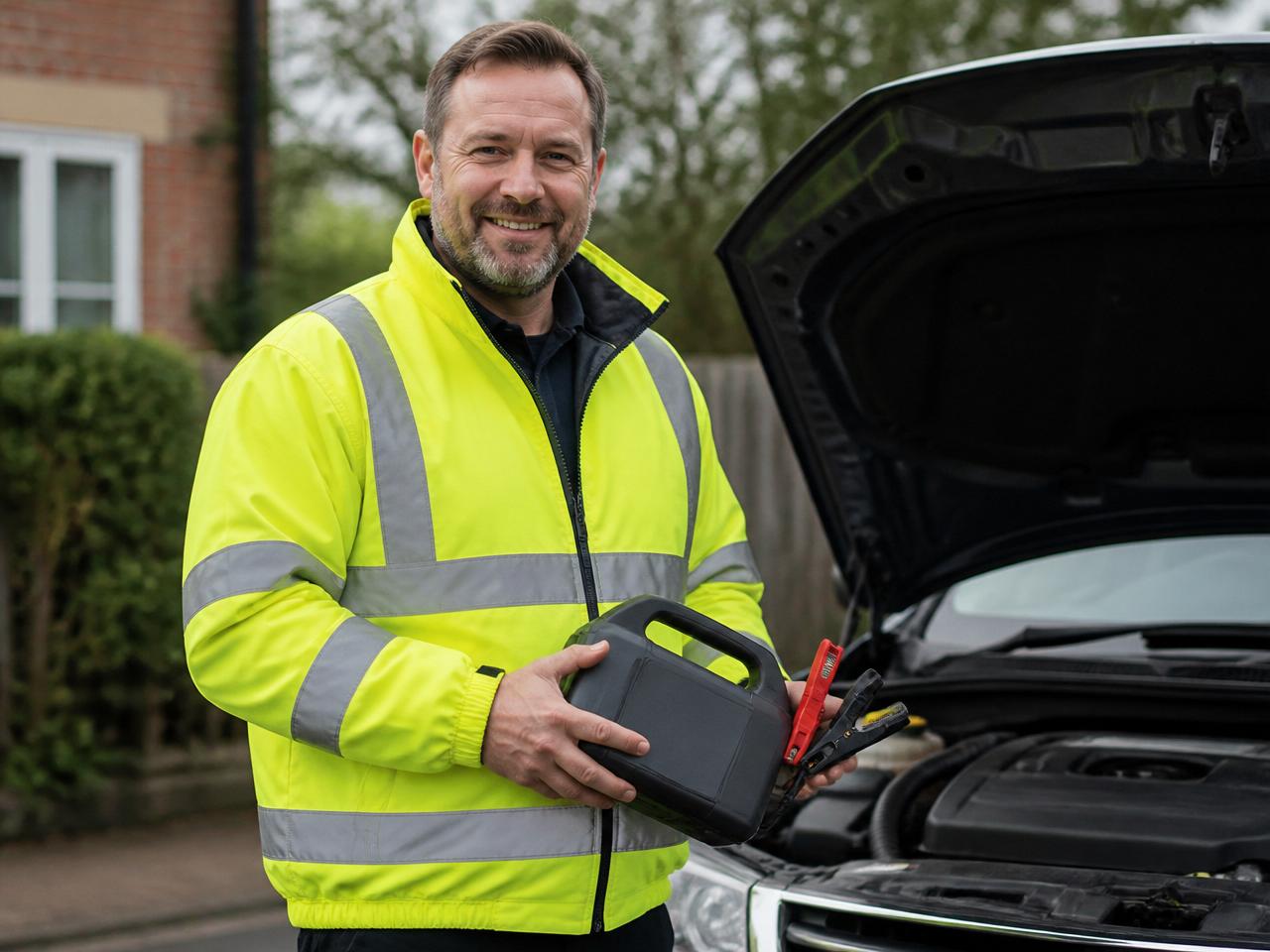
Cold thickens engine oil and slows the chemical reaction inside the battery at the same time, so a pack that copes fine in September can be 30% short of its rated cranking current in January. That gap is measurable, which means it is also predictable.
If your work van is stone dead around Harborne, don't book recovery yet. Most van no-starts near the M6 J6 (Spaghetti Junction) corridor are cured with a mobile jump and a proper alternator/battery health check on the driveway.
Diesel vans need real cranking amps — a jump pack designed for cars won't spin a 2.0 or 2.2 diesel that's been standing cold. Our kit is spec'd for commercials.
Why cold weather exposes a tired battery
We see clusters of these calls after the first hard frost, especially from short-journey drivers whose alternator never gets long enough to top the battery back up.
Locally that means the streets between Harborne and Birmingham, with access via M6 J6 (Spaghetti Junction) and A38(M) Aston Expressway and a practical radius reaching Birmingham (~3 mi) and Smethwick (~3 mi).
The tests that predict a winter no-start
- Parasitic draw is measured where the pattern suggests overnight drain rather than genuine age.
- Charging system output is checked at idle and at 2,000rpm, since a weak alternator makes cold-start symptoms appear months early.
- AGM and EFB stop-start vans handled correctly — no fitting a standard flooded battery in an AGM slot
- Every van jumpstart finishes with a charging-system reading, so the same fault does not reappear next week.
Local reference data — Harborne
- Nearest major town
- Birmingham (~3 miles)
- Page focus
- Slow crank on cold mornings
- Local commercial context
- professional services and hospitality
- Local authority
- Birmingham City Council
- Reference point
- Queen Elizabeth Hospital
- Postcode districts
- B17
Typical callers with this symptom
Commuters in Harborne whose first journey of the day is short and cold, which is the hardest possible duty cycle for a battery.
Domestically, Edwardian villas and modern apartments dominate around here, which shapes how these jobs are accessed and worked.
Recent cold-start jobs nearby
Recent job nearby: an estate car on a driveway off M6 J6 (Spaghetti Junction), cranking slowly for a week. Rated 640 CCA, tested at 310 — replaced with a matched unit and the slow crank went away entirely.
Recent job nearby: a small city car near Queen Elizabeth Hospital that started fine on test but showed a 0.4A parasitic drain from an aftermarket accessory — the real cause of the morning struggle.
How the visit runs
- 1
Phone diagnosis
Van make, model, engine size and symptom — we already know if it's a battery, alternator or starter pattern.
- 2
Fixed quote
Price agreed before we set off. Includes callout, jumpstart and full electrical health check.
- 3
On-site test
Voltage, load, alternator output at 2000 rpm, parasitic draw. Real numbers, not guesses.
- 4
The tests that predict a winter no-start
Charging system output is checked at idle and at 2,000rpm, since a weak alternator makes cold-start symptoms appear months early.
Cold starting questions
Q.Would a battery charger fix it instead?
A conditioning charge helps a battery that is merely undercharged. It cannot restore lost plate capacity, which is what causes genuine cold-crank failure.
Q.Do you cover Harborne and the B17 area for this?
Yes. Harborne is inside our routine coverage from Oldbury via M6 J6 (Spaghetti Junction), roughly 3 miles from Birmingham. We cover it alongside Birmingham and the surrounding streets.
Q.My van cranks slowly then dies — is that the battery?
Usually yes, but sometimes it's the starter drawing too much current or a bad earth. We test all three on the driveway before recommending a replacement.
Q.What if the van battery keeps going flat every week?
That's parasitic drain — usually a dashcam, tracker or aftermarket electrics wired to permanent live. We do a milliamp draw test and identify the circuit.
Q.My car starts fine in the afternoon — is the battery still bad?
Very likely. Warm batteries deliver far more current than cold ones, so a failing pack can pass at midday and fail at 6am. The cold cranking test settles it.
Q.How long have I got before it strands me?
Once cranking voltage drops under 9.6V regularly, most batteries give a few weeks at best, and less if the weather turns. We give you the actual reading so you can decide.
Areas we reach quickly from here
As a neighbourhood of Birmingham, Harborne is covered alongside its parent town, so a slow crank on cold mornings call from any of them routes to the same engineer.
Why this is safe to book
- Replacement batteries are matched to the vehicle's original specification — including EFB and AGM where the car requires it.
- Old batteries removed and recycled on every van jumpstart.
Cranking slowly? Get a number, not an opinion.
Van Jumpstart plus a full charging-system check, with a matched battery on the van if it needs one. Ask for a van jumpstart and quote your postcode — B17 is a routine run for us.
Related pages
- 24/7 Emergency Jumpstart — slow crank on cold mornings in Harborne
- Battery Replacement — slow crank on cold mornings in Harborne
- Start-stop and AGM systems — van jumpstart in Harborne
- Fleet and depot contracts — van jumpstart in Harborne
- Same-hour response — van jumpstart in Harborne
- Slow crank on cold mornings in Birmingham (~3 mi)
- Slow crank on cold mornings in Smethwick (~3 mi)
- Slow crank on cold mornings in Sutton Coldfield (~7 mi)
- Slow crank on cold mornings across Birmingham
- Van Jumpstart in Harborne — main page
- All jumpstart services in Harborne
The short version
Slow cold cranking is the one battery fault that gives you warning. Measured properly in Harborne, it turns an unplanned breakdown into a planned ten-minute visit. If you would rather plan it than react to it, a van jumpstart can be booked for a time that suits.
Stranded with a flat battery?
Call now or send a WhatsApp — we'll confirm your quote and dispatch the nearest engineer.