
Mobile car jumpstart · Slow crank on cold mornings
Slow Cranking On Cold Mornings — Car Jumpstart, Halesowen
Winter starting trouble around B62? We measure cold cranking performance rather than guessing. Mobile car jumpstart with same-visit replacement.
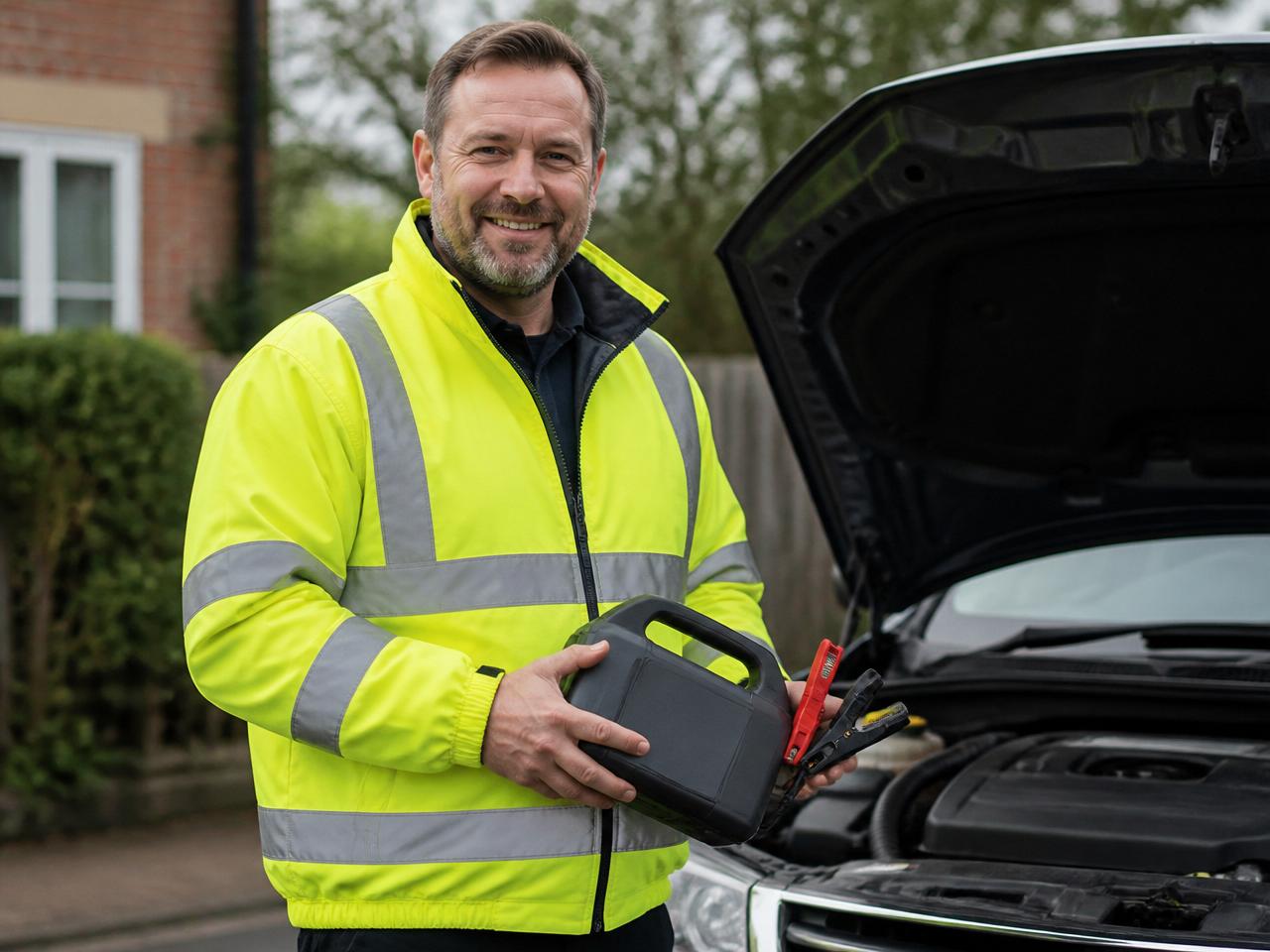
A battery rarely dies in one go. It loses cold cranking amps gradually, and the first sign is a starter that drags for a second longer than it used to on a frosty morning — while starting perfectly at lunchtime.
Around Halesowen we jumpstart cars every day — from tiny Fiat 500s outside terraces on B62, up to big Range Rovers and BMW X5s with dual AGM setups.
Cars in Halesowen get a lot of school-run and short-hop use, and that's the number-one killer of car batteries — the alternator never gets long enough to fully replace what the starter took out.
Recent cold-start jobs nearby
Recent job nearby: an estate car on a driveway off M5 J3, cranking slowly for a week. Rated 640 CCA, tested at 310 — replaced with a matched unit and the slow crank went away entirely.
Recent job nearby: a small city car near Halesowen that started fine on test but showed a 0.4A parasitic drain from an aftermarket accessory — the real cause of the morning struggle.
The tests that predict a winter no-start
- Cranking voltage is watched live — anything dipping below 9.6V while turning over indicates a battery near the end of its usable life.
- Cold cranking amps are tested against the figure printed on the battery label, not against a generic pass mark.
- Battery registration via OBD for BMW, Audi, VW, Mercedes, Ford, Vauxhall and Peugeot/Citroen where required
- Every car jumpstart finishes with a charging-system reading, so the same fault does not reappear next week.
Catch it before the frost does
A ten-minute cold cranking test in Halesowen is cheaper than a morning spent waiting at the kerb. We route in via M5 J3, roughly 8 miles out from Birmingham.
Why cold weather exposes a tired battery
We see clusters of these calls after the first hard frost, especially from short-journey drivers whose alternator never gets long enough to top the battery back up.
Locally that means Halesowen itself plus the neighbourhoods that feed into it, with access via M5 J3 and A456 Manor Way and a practical radius reaching Cradley Heath (~2 mi) and Hasbury (~1 mi).
Cold starting questions
Q.Would a battery charger fix it instead?
A conditioning charge helps a battery that is merely undercharged. It cannot restore lost plate capacity, which is what causes genuine cold-crank failure.
Q.Do you cover Halesowen and the B62 area for this?
Yes. Halesowen is inside our routine coverage from Oldbury via M5 J3, roughly 8 miles from Birmingham. We also cover the surrounding neighbourhoods on the same run.
Q.How long should I drive after a jumpstart?
Ideally 30–45 minutes of continuous driving, not stop-start town use. But if the battery is old and the alternator can't get it above 12.6V at rest, it'll go flat again in days.
Q.How long does a car jumpstart take?
From arrival, most jobs are done in 15–20 minutes including a full electrical health check. If we're fitting a new battery we're usually finished inside 40 minutes.
Q.My car starts fine in the afternoon — is the battery still bad?
Very likely. Warm batteries deliver far more current than cold ones, so a failing pack can pass at midday and fail at 6am. The cold cranking test settles it.
Q.How long have I got before it strands me?
Once cranking voltage drops under 9.6V regularly, most batteries give a few weeks at best, and less if the weather turns. We give you the actual reading so you can decide.
Typical callers with this symptom
Drivers of older vehicles on 1930s semis who would rather replace on their own terms than be stranded.
Domestically, 1930s semis and hillside estates dominate around here, which shapes how these jobs are accessed and worked.
Local reference data — Halesowen
- Main routes
- M5 J3 · A456 Manor Way · A458
- Reference point
- Hillside Dudley borough town straddling the M5 J3 corridor into south-west Birmingham.
- Postcode districts
- B62, B63
- Local commercial context
- retail and small manufacturing
- Area type
- Town / district hub
- County
- West Midlands
How the visit runs
- 1
The tests that predict a winter no-start
Cold cranking amps are tested against the figure printed on the battery label, not against a generic pass mark.
- 2
Describe the symptom
Click, silence, dashboard flicker, or engine turning slowly — each has a different likely cause.
- 3
Fixed price
Quoted on the call from your postcode and vehicle, no surprises on arrival.
- 4
Test then jump
We measure the battery before touching it, so we know if it's a jump or a replacement.
Areas we reach quickly from here
Halesowen sits about 8 miles from Birmingham, and the same van covers Cradley Heath (~2 mi), Hasbury (~1 mi) and Quinton (~2 mi) on the same run.
Why this is safe to book
- We quote the rated CCA against the measured CCA so the decision is yours, based on a number.
- Old batteries removed and recycled on every car jumpstart.
Related pages
- 24/7 Emergency Jumpstart — slow crank on cold mornings in Halesowen
- Battery Replacement — slow crank on cold mornings in Halesowen
- Trade van, first job of the day — car jumpstart in Halesowen
- Fleet and depot contracts — car jumpstart in Halesowen
- Workplace and staff parking — car jumpstart in Halesowen
- Slow crank on cold mornings in Cradley Heath (~2 mi)
- Slow crank on cold mornings in Hasbury (~1 mi)
- Slow crank on cold mornings in Quinton (~2 mi)
- Slow crank on cold mornings in Quinton
- Car Jumpstart in Halesowen — main page
- All jumpstart services in Halesowen
The short version
The useful thing about winter starting trouble is that it is predictable. Test the cold cranking figure, compare it to the label, and act while the car still starts. Locally this is handled alongside Cradley Heath and Hasbury, so the van is rarely far away.
Stranded with a flat battery?
Call now or send a WhatsApp — we'll confirm your quote and dispatch the nearest engineer.